
This piece adapts operational learnings originally published by Francisco Crizul, CTO of Deri, our all-in one logistics company.
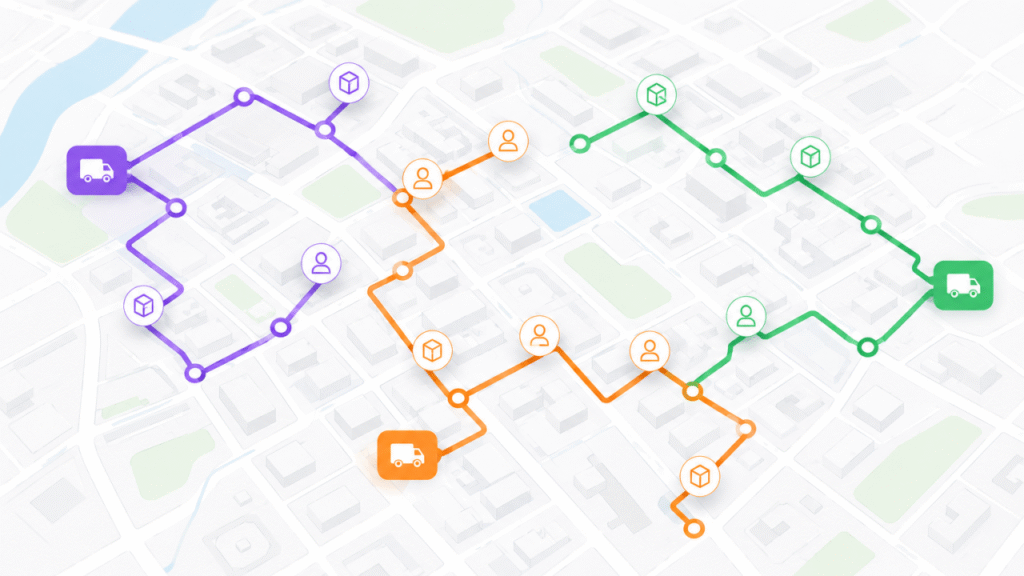
In an earlier piece, Francisco wrote about one of the problems that interests him most in logistics: last-mile route optimization.
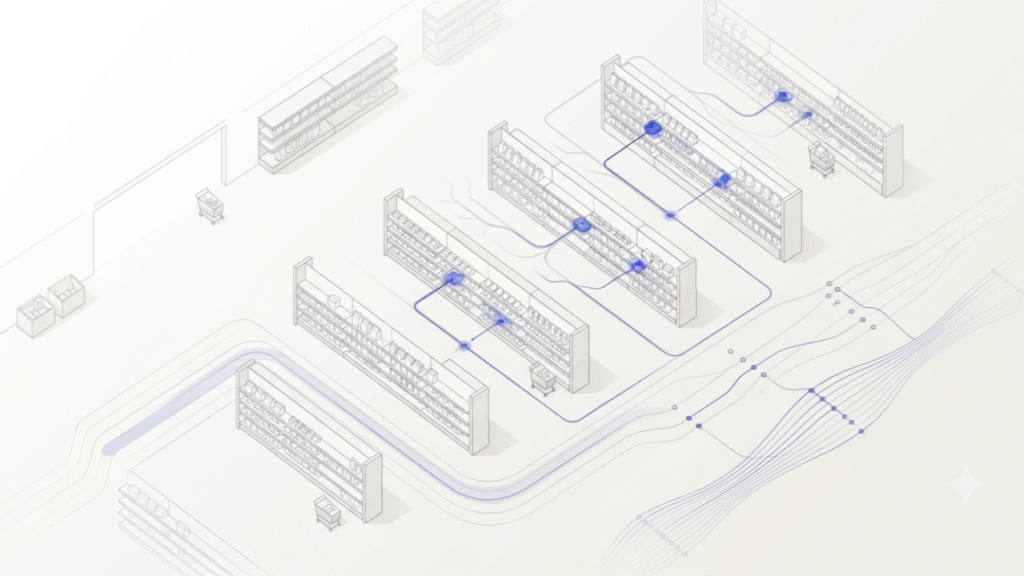
There is a natural continuity with a problem that happens a few meters earlier in the chain: what is the best order in which to prepare a batch of orders inside a warehouse or a supermarket?
At first glance, picking can look like a much simpler problem.
There are no hundreds of kilometers of streets, no traffic, no vehicles crossing a city.
There is a warehouse or a store, products, locations, and people who need to collect them.
But once the problem is applied to a real operation, especially a supermarket, it quickly becomes clear that the inside of a warehouse or store can be just as complex as the outside.
In some ways, even more chaotic.
The problem is not simply finding the shortest path
Suppose there is a picking wave with hundreds of lines.
Each line has a product, a quantity, and a location.
The initial objective seems obvious: order the locations so the picker travels the shortest possible distance.
But other questions quickly appear.
Which orders should belong to the same wave?
Which products should be grouped together?
In what order should locations or aisles be visited?
Which locations should be prioritized?
What happens if a shelf is disorganized or partially empty?
What happens if the real layout of the supermarket does not match the planogram?
How does daily product rotation on shelves affect the process?
What happens when a product was «temporarily» relocated?
What happens when the stock in the system does not match physical reality?
How does the sequence change when a real-time exception appears?
In supermarkets this becomes even more critical, because unlike a warehouse, the layout changes constantly due to restocking, is modified by commercial campaigns, is adjusted by marketing decisions, breaks down due to lack of operational time, and rarely stays exactly as it was designed.
The problem stops being «what is the shortest path?» and becomes «what is the preparation order that allows efficient picking in an environment that is always changing?»
The main enemy: time (and the lack of it)
In supermarket operations there is one reality that defines everything: there is no time to keep the system perfect.
The layout changes.
Products move.
Shelves get reorganized.
Promotions force merchandise to be relocated.
Staff rotates.
Restocking happens in parallel with picking.
And all of this happens while the operation keeps running.
This creates a structural problem: the ideal system (planogram, locations, logical order) never matches the real system (the operating store).
That difference is not marginal.
It is constant.
It is daily.
And it is the main enemy of efficiency.
The challenge of maintaining locations in supermarkets
Anyone who has worked in retail knows this reality: perfect locations exist in the warehouse design, not in the store.
In theory, it is possible to design an ideal supermarket: high-rotation products in hot zones, categories grouped logically, perfectly labeled shelves, correctly recorded stock, a stable layout, and controlled restocking.
In practice: a product ends up on another shelf because «there was no room,» a promotion displaces entire categories, an urgent restock breaks the order, staff prioritizes speed over accuracy, and the system does not reflect changes in real time.
Little by little, a gap appears between how the supermarket should be organized and how it is actually organized at that moment.
This does not mean the planogram is not important. It is.
But there is an operational reality to accept: keeping a supermarket perfectly organized at all times is practically impossible.
Technology has to start from that reality.
Systems cannot be built that depend on everything being perfect.
They have to be built to function in the middle of real operational disorder.
Designing to coexist with chaos
This is one of the most important ideas when thinking about technology for retail and logistics.
The structural problem cannot always be solved.
The layout can be improved.
Planograms can be defined.
Restocking rules can be established.
Inventory control can be improved.
But exceptions will always exist.
Because of that, a good technology solution should not assume «the supermarket is perfectly organized.»
It should assume «the supermarket has a defined structure, but it also has constant deviations.»
And the optimization should be able to work with both realities at the same time.
The picking wave as an optimization problem
Once that reality is accepted, building a picking wave becomes a much more interesting problem.
It is not only about deciding which orders to prepare together.
It is also about deciding how to move through the locations or aisles needed to prepare them.
The problem can be thought of in different levels.
Level 1: Order selection
Determine which orders should be part of the same batch or wave.
Typical variables: priority, delivery time, customer, zone, volume, weight, number of lines, order type, and real stock availability.
Level 2: Grouping
Look for combinations of orders that make operational sense.
In supermarkets this is especially important because many orders share categories, some routes naturally overlap, some zones of the store are more efficient than others, and congestion varies by time of day.
But grouping orders only by product proximity is not enough.
It is also necessary to consider the picker’s operational capacity, aisle congestion, restocking times, shelf accessibility, commercial priorities, and the store’s dynamics at that moment.
Level 3: Sequencing
Once the wave is defined, the central problem appears: in what order should the store or warehouse be traveled?
This is where route optimization comes in directly.
A poor sequence in a supermarket can mean blocked aisles, unnecessary backtracking, crossings with restocking staff, time lost looking for misplaced products, and high variability in preparation time.
A good sequence can drastically reduce total picking time.
Level 4: Real-time adaptation
Finally, reality changes constantly: a shelf is being restocked, a product is not where it should be, an urgent order appears, a delivery priority changes, an aisle is blocked, or physical stock does not match the system.
The solution has to be able to adapt without collapsing.
There is not always a single optimal order
Another important conclusion is that there is not always one single correct answer.
Two sequences can have similar distances but very different operational behavior.
For example:
Sequence A: fewer meters traveled, but constant crossings with restocking staff and aisle congestion.
Sequence B: a few extra meters, but a more stable flow, fewer interruptions, and more predictable execution.
In supermarkets this is key: efficiency is not only distance, it is operational fluidity.
Just as in last-mile routing, distance matters, but it is not the only relevant metric.
The location problem is dynamic by definition
In retail this is even more extreme.
The layout is not static. It is a living system.
Shelves change, products rotate constantly, promotions reconfigure spaces, demand varies by hour and day, restocking alters the physical order, and daily operations rewrite the map.
Because of this, a solution based on a fixed map loses accuracy very quickly.
The challenge is combining the theoretical structure of the supermarket with the operational reality of the moment.
Multilevel algorithms
This type of problem leads to a clear conclusion: a single algorithm cannot solve all the complexity.
The optimization has to be divided into levels: orders, grouping, locations, sequence, evaluation.
Each level has different objectives: operational efficiency, congestion reduction, minimizing travel distance, execution stability, and real-time adaptability.
The goal is not to find a perfect solution from the start.
It is to progressively reduce the problem until reaching a solution that is executable in the real conditions of the store or warehouse.
Where does machine learning fit in?
This is one of the most interesting parts.
Not every decision needs to be a fixed rule.
With historical data, it is possible to start understanding real patterns: which shelves generate more picking errors, which products tend to be misplaced, which routes are more stable, which zones of the supermarket generate more congestion, which time slots are more efficient for picking, which order combinations work best, which locations are more likely to be disorganized, and which sequences reduce interruptions.
Machine learning can help predict which decisions have a higher probability of operational success.
It does not replace optimization. It complements it.
The system can learn from real operations
A supermarket is not static, and its behavior changes constantly.
Because of that, a solution that works today may not work tomorrow.
The optimization should learn from what happens in the real operation: which sequences were most efficient, which layouts generated less friction, which types of waves worked better, which zones of the supermarket are more problematic, and which patterns repeat within the operational chaos.
Over time, the system stops being just a set of rules.
It becomes a system that learns from the store’s real behavior.
From optimizing routes to optimizing decisions
This concept connects directly to the last-mile problem.
In both cases there is an initial temptation: «find the shortest route.»
But the real problem is much broader.
In last mile: orders, vehicles, drivers, constraints, routes.
In supermarkets: orders, wave, shelves, sequence, picking.
In both cases, the route is only one part of a chain of decisions.
And the more chaotic the operation, the more important that chain becomes.
The real challenge
For Francisco, the challenge of picking in supermarkets is not building a perfect algorithm.
It is building one that works in an environment where the layout changes constantly, product order is not maintained, the operation does not have time to correct everything, and reality never matches the system.
That is why, at Deri, the team is working on a strategy that combines multilevel optimization with historical data and machine learning to recommend the best possible picking order at any given moment, even when the store is far from perfect.
Because in the end, just as in routing: it is not about finding the ideal route in a perfect world.
It is about finding the best possible decision in a world that never stops moving long enough to be put in order.
And perhaps that is the true complexity, and also the opportunity, of modern logistics: optimizing systems that are never still.
Originally posted at: https://www.linkedin.com/pulse/m%C3%A1s-all%C3%A1-del-picking-c%C3%B3mo-optimizar-una-ola-en-un-dep%C3%B3sito-crizul-odzjf