
This piece adapts operational learnings originally published by Francisco Crizul, CTO of Deri, our all-in one logistics company.
Early in his career, Francisco had the opportunity to work at IKI (selliki), a startup in Mexico founded by Uruguayan entrepreneurs, built on an ambitious and, from the start, brilliant idea: an integrated shopping experience spanning digital and physical retail.
IKI sold to retailers, handling the operational and logistics work so those retailers could get products to the end customer. In other words, the retailers made the sale, while IKI absorbed most of the complexity of execution.
As is common in startups of this kind, the complexity was never in the idea itself, but in the operation. Over time, it became clear that one of the hardest problems to solve, and in some sense the operation’s Achilles’ heel, was logistics.
Francisco’s role was mainly focused on e-commerce development, using Shopify services and building the frontend in Flutter.
From that vantage point, it would be easy to assume the main challenge is building a good digital experience: products, cart, checkout, payments, promotions, everything needed for someone to complete a purchase.
But working inside the operation taught him something that, years later, would go on to shape how he thinks about technology:
The sale doesn’t end when the customer clicks «buy.»
In reality, that’s where a whole other part of the problem begins, one that often stays off screen.
Logistics.
E-commerce can work perfectly, and still fail
You can have:
- a correctly built catalog
- updated prices
- a fast checkout
- an approved payment
- a purchase confirmation
- an excellent user experience.
And then the most important question shows up:
Where is the order?
That’s where a completely different system takes over.
The order has to leave somewhere.
It has to be prepared.
It has to be consolidated.
It has to be assigned.
It has to be transported.
It has to arrive.
Each of those steps generates information.
If that information isn’t connected, a problem appears that can be far bigger than a technical bug:
traceability is lost.
When we don’t know what happened
One of the biggest lessons from that experience, Francisco explains, was understanding that traceability isn’t simply a feature of a logistics system.
It’s a tool for the business.
Imagine an order that should have arrived yesterday.
The customer asks:
«Where is my order?»
And the system can only answer:
«It’s in process.»
That status probably isn’t enough.
Is it being prepared?
Has it already been prepared?
Is it waiting for dispatch?
Was it assigned to a vehicle?
Did the vehicle leave?
Was a delivery attempted?
Was there an incident?
Did it return to the warehouse?
Is it waiting for reassignment?
If those questions can’t be answered, the organization starts operating blind.
And when there’s no traceability, manual decisions take over.
Phone calls.
Messages.
Spreadsheets.
Back-and-forth between teams.
Searches.
Assumptions.
Each of those adds time and the possibility of error.
In some cases, the lack of traceability doesn’t just create operational inefficiencies. It also makes it hard to reconstruct with certainty what happened to an order. A product that «never arrived,» «arrived damaged,» or «doesn’t match what was ordered» can have multiple possible explanations across the logistics chain. Without enough information at each stage, telling apart an operational error, a genuine incident, or a bad assignment becomes nearly impossible.
Logistics connects many parts of the business
Another lesson from working in operations like this one is that logistics isn’t isolated.
It’s connected to practically everything.
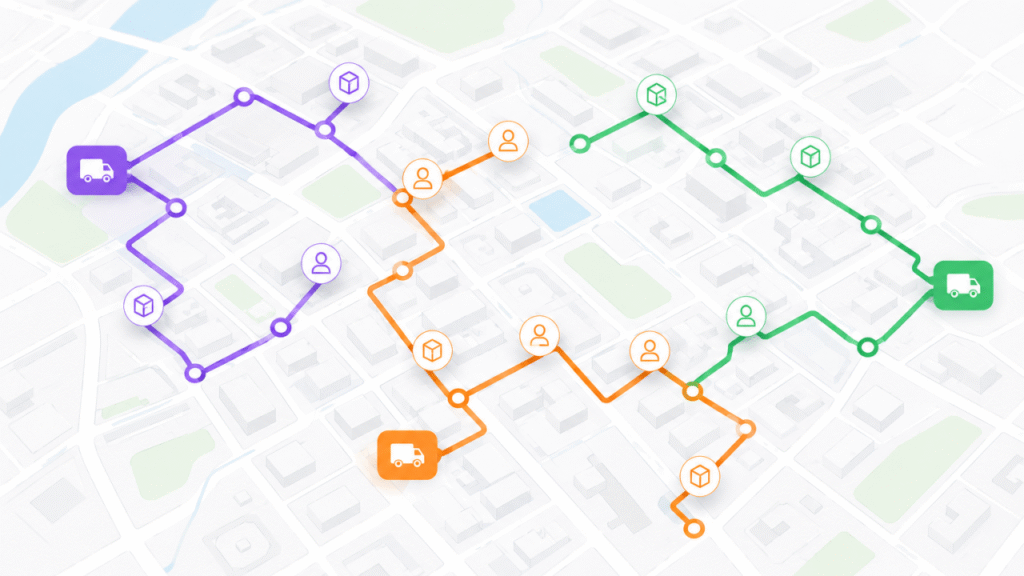
E-commerce → stock → picking → dispatch → transport → delivery → customer
A failure at any one of those points can end up affecting the entire experience.
An order can be sold correctly but not exist physically.
Stock can exist but be in the wrong location.
An order can be prepared correctly but never dispatched.
It can be dispatched but not assigned correctly.
It can be assigned but never delivered.
And when an exception happens, the business needs to know exactly where the process broke down.
That’s why a logistics platform shouldn’t just record statuses.
It should make it possible to reconstruct the history of an operation.
Traceability also supports decision-making
When there’s enough information, traceability stops being just a support tool.
It becomes information for improving the operation.
You can start answering questions like:
Where are most delays generated?
Which stages have the highest number of incidents?
Which zones have the most delivery problems?
What types of orders generate the most exceptions?
How long does an order sit at each stage?
How many orders require manual intervention?
Which operators have the longest handling times?
Which routes generate the most problems?
How much time passes between an order being prepared and being dispatched?
Those questions make it possible to move from:
«What happened with this order?»
to:
«Why is this problem happening, and how can we prevent it from happening again?»
That shift is enormous.
The exception is also part of the process
In any real operation, exceptions will happen.
An order might have no stock.
A product might be in a different location than expected.
A vehicle might not be available.
A customer might not be home.
A route might be disrupted.
An order might need to go back to the warehouse.
An operator might make a mistake.
The goal of a good system shouldn’t be to assume these situations won’t happen.
It should be able to detect them, log them, and make them visible.
Because an exception that isn’t logged turns into a manual investigation.
And a manual investigation costs time.
What Francisco learned, and how it carried over to Deri
Years later, working at Deri, many of these ideas are still present.
When the team designs a logistics feature, they don’t just think about what it should do.
They also ask:
What information does it generate?
What state does it leave behind?
Who needs to see it?
What happens if something fails?
How can we reconstruct what happened?
What decisions will we be able to make with that information later?
This becomes especially important as automation and algorithms get introduced.
Because the more decisions a system makes on its own, the more important it becomes to know why it made a given decision and what information it used to make it.
Automation without traceability can turn into a black box.
And in logistics, a black box can be very difficult to operate.
Along these lines, Francisco and Diego Bermúdez have been working on exactly this problem: making sure logistics stops being a problem in itself, whether the issue is the operation itself or the lack of information about it. At Deri, the goal is unified, end-to-end traceability, so that every actor in the chain can understand what’s happening in real time, without depending on fragmented systems or manual interpretation.
From selling products to managing operations
One of the biggest takeaways from the IKI experience was understanding that e-commerce and logistics can’t be treated as separate worlds.
The customer sees a purchase.
But behind that purchase is a chain of decisions and operations.
The digital experience is only the visible part.
Behind it sits an entire infrastructure that has to make that promise real.
And when that infrastructure fails, the customer doesn’t distinguish between e-commerce, logistics, stock, or transport.
For them, there’s only one thing:
«My order didn’t arrive.»
That’s why technology has to connect those worlds.
Traceability as the foundation for optimization
Today, when the Deri team talks about route optimization, picking, automatic assignment, consolidation, or multi-level algorithms, there’s a precondition Francisco considers fundamental:
Reliable information about what’s happening is required.
You can’t optimize what you can’t observe.
You can’t learn from an operation if you have no data about it.
And it’s hard to automate correctly if you don’t understand what happened before.
That’s why, often, logistics innovation doesn’t start with an algorithm.
It starts with something much more basic:
end-to-end traceability.
The lesson that stuck
Working in this kind of operation gave Francisco a different way of seeing logistics.
Not just as a transportation problem.
But as a fundamental part of the customer experience and of how the business functions.
That may be one of the central ideas he still carries with him:
When logistics loses traceability, the problem stops being just a logistics problem.
It becomes a problem of service.
Of information.
Of operations.
Of cost.
Of trust.
And ultimately, of business.
Today, at Deri, much of the team’s challenge is building technology that connects these processes, makes them visible, automates them where it makes sense, and uses the information generated to make better decisions.
Because efficient logistics starts with understanding the whole process: from order preparation to final delivery, with visibility at every stage.
Originally posted at: https://www.linkedin.com/pulse/cuando-la-log%C3%ADstica-pierde-trazabilidad-el-problema-deja-crizul-tm1if